Two free skills for your coding agent: one finds a name and checks whether it's taken, the other builds three brand directions and a kit for the one you pick, and both tell you what they couldn't check.
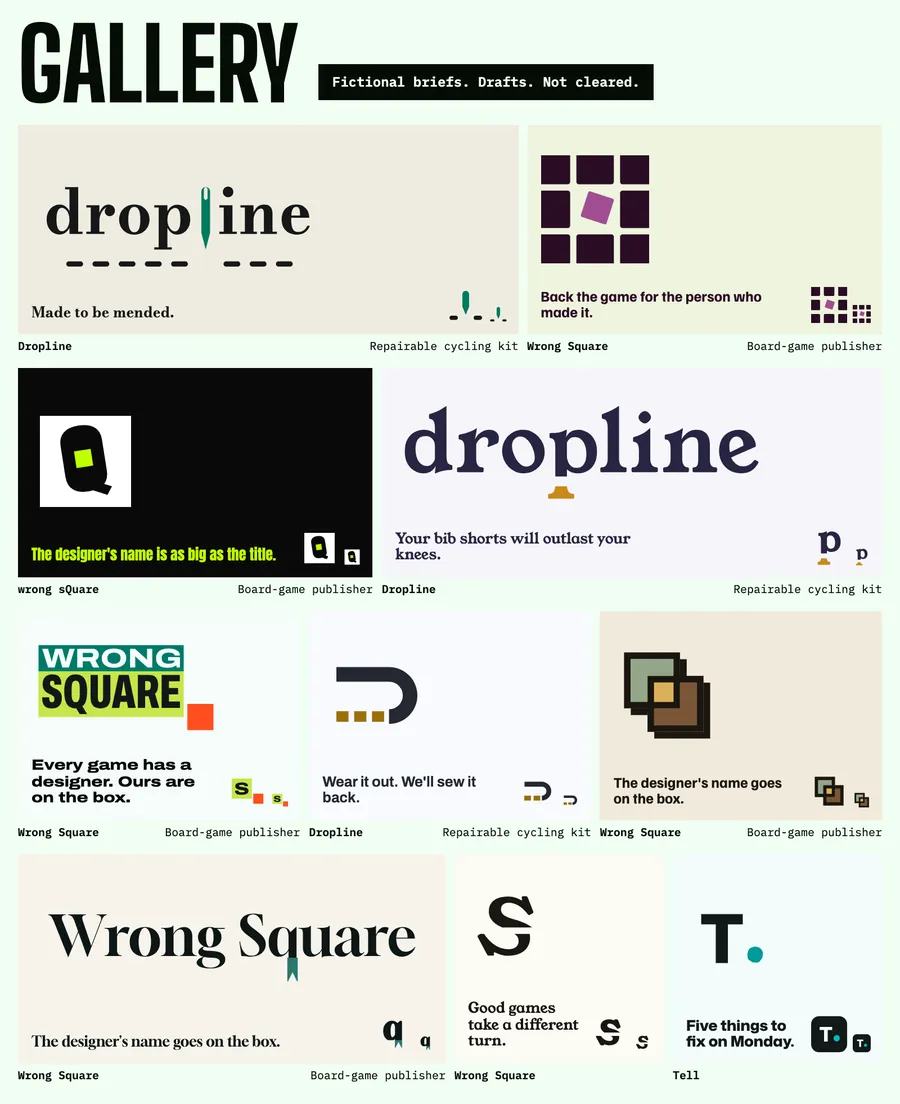
Real output from the skill, cropped. Fictional briefs. Drafts, not cleared.The gallery
NamesSame model, same briefs
Ask plainly and you get Ledgerline.
That one came up for a security scanner and again for legal software. Below, on five fictional briefs: Claude Sonnet told to "suggest 6 names", then the naming skill on the same model. Read the reasons.
Attack-surface scanner
Asked plainly
Plainsight
Surfacewalk
Ledgerline
Tallyho
With the skill
Tipoff
Attackers don't hack, they notice. This is the quiet word you get before it matters.
Orphan
Engineers already say orphaned accounts for assets whose owner has left.
Tenuki
In Go, ignoring the local fight to play elsewhere, as attackers do.
Eczema skincare in Germany, the Netherlands and the UK
Asked plainly
calma
nulla
tolera
With the skill
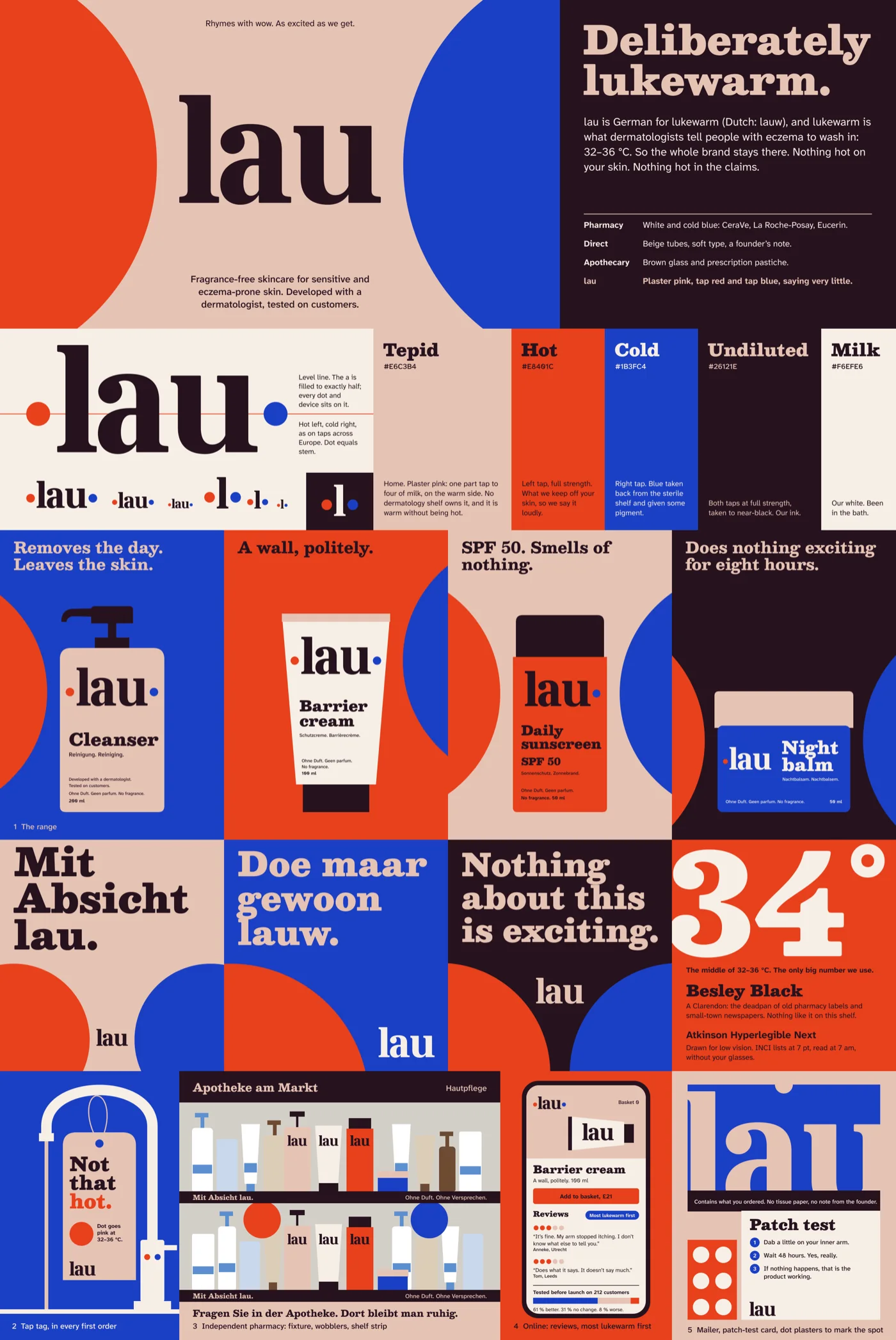
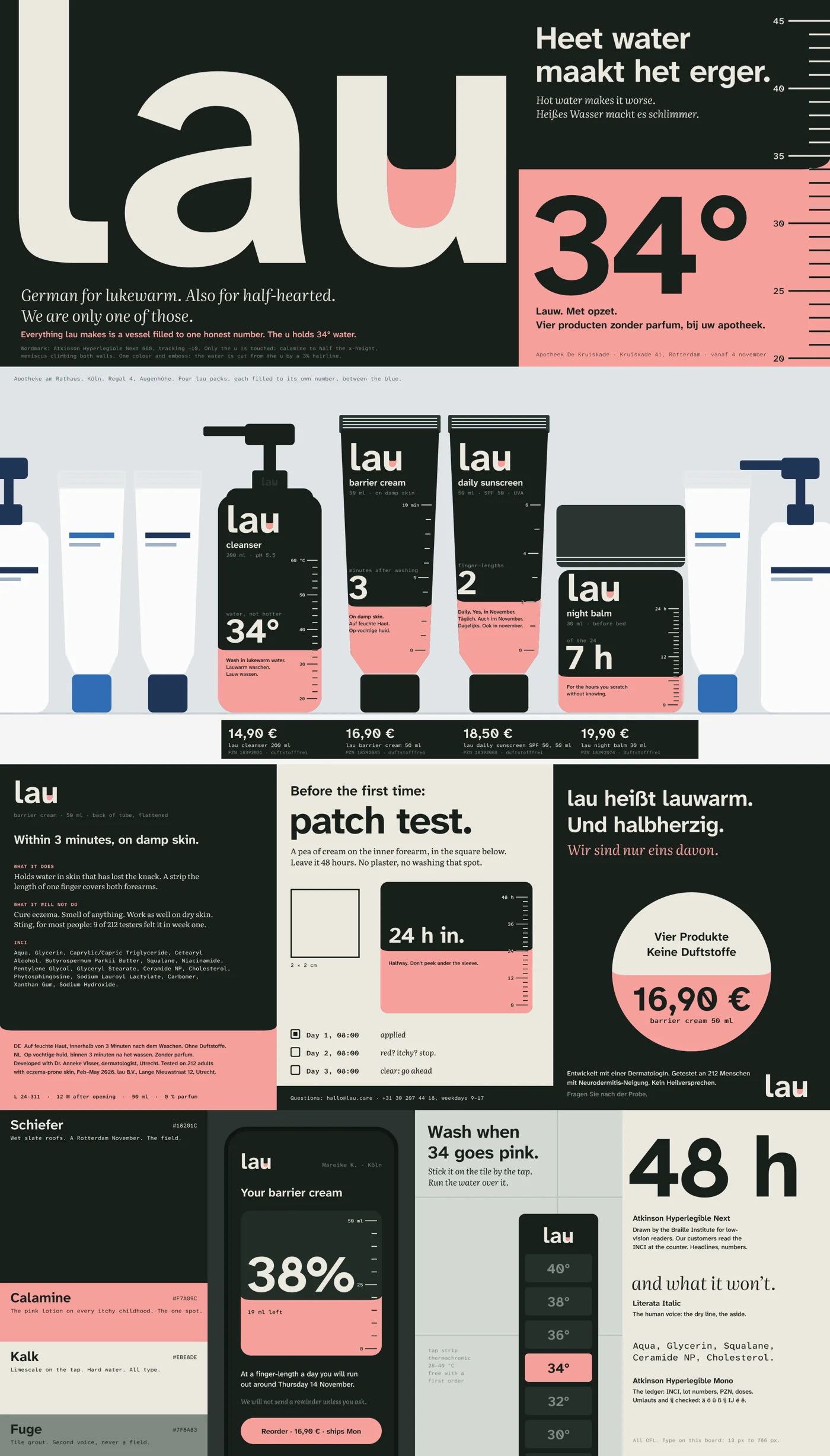
lau
The first thing every patient is told is lukewarm water, and lau is German for lukewarm.
still
Means quiet in all three markets.
fine
The answer to "how's your skin?"
Small-firm legal software
Asked plainly
Lantern
Harbor
Firmly
Ledgerline
With the skill
Tenth
Lawyers bill in tenths of an hour.
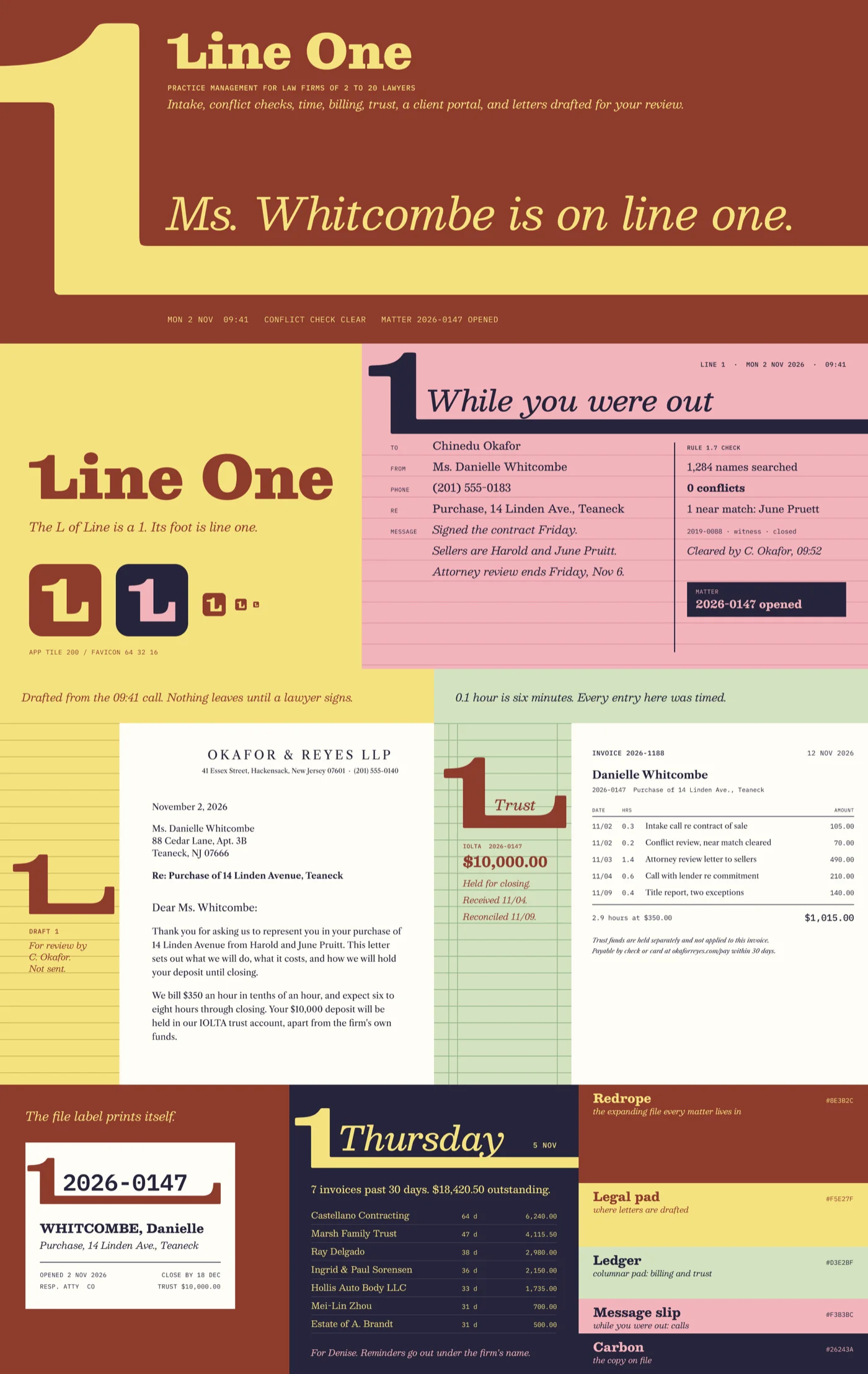
Line One
"Mrs. Alvarez on line one."
Shingle
A lawyer hangs out a shingle to open a practice.
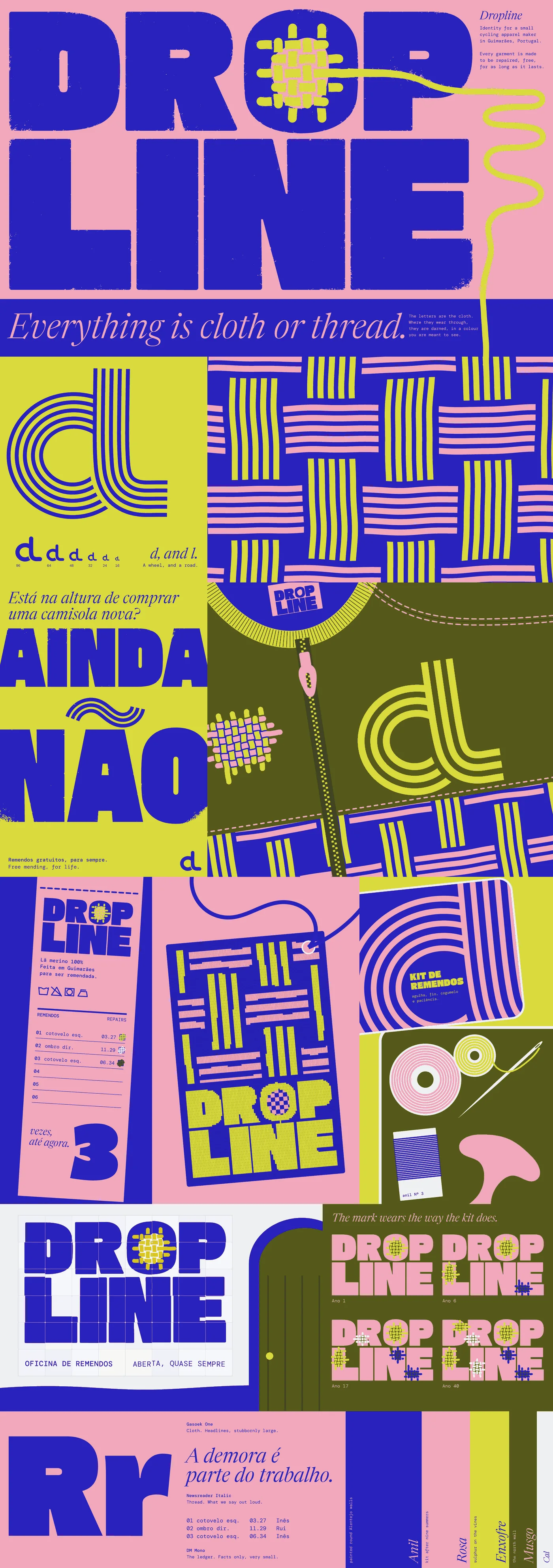
Repairable cycling kit made in Portugal
Asked plainly
Mend
Estrada
Darn
With the skill
Trinta
Riders wash kit at 30 degrees, and trinta is thirty in Portuguese.
Devagar
Portuguese for "slowly", from "devagar se vai ao longe".
Bartack
The stitch that reinforces where bib straps fail.
Board-game publisher
Asked plainly
Marginalia Games
Lanternworks
Open Table Press
With the skill
Colophon
The credit page of a book.
Fair Copy
The clean final version made from a messy draft.
From the eval runs on Claude. Plain output came with one-line reasons too, and they're in the results. No name here is cleared, and any of them may coincide with a real company. In fairness, plain output also reached Colophon once, as Colophon Games. Some briefs have one obvious clever word. On Codex with gpt-6.1-terra the skill did worse: see the numbers.
What models reach for1,688 names, 6 models, 8 unrelated briefs
Neutral prompt. Claude Haiku, Sonnet and Opus, Codex gpt-6-luna and gpt-6.1-terra, Cursor auto. Cursor is partial, because the Free plan hit a limit. The skill carries this list and has to justify anything on it.
BrandingBlind panel, 3 briefs, 2 judges
A strong prompt still beats the skill.
Same job on the same top-tier budget: a whole visual world on one board. On the direction the skill recommends, the prompt won on both agents, and it cost about a fifth as much. The skill is close on Claude, and clearly weaker on Codex. If you want one deep identity, use this.
4.67
Strong prompt on Claude Opus. About $3 a run. On Codex, 3.40.
4.27
The skill's recommended direction on Claude. About $14 a run. On Codex, 2.50.
1 of 3
Briefs on Claude where the best of the skill's three directions beat the prompt. +0.23 on average, carried by one brief. On Codex, 0 of 3, -0.90.
On Codex: use the naming skill, with codex -m gpt-6.1-sol. For one deep identity, use the one prompt: it scored 3.40 against 2.50, and no direction beat it. Use the branding skill there only if you want the three directions, the checks and the kit.
Three briefs, one run each, two LLM judges, scores 1 to 5. A small sample. Re-judging moves scores, so treat differences under about 0.4 as noise, and Claude's gap here is 0.40. These same three briefs have now been through four rounds, so they're no longer held out. A fresh set would be fairer. The tables. The method.
Read this win with care. The prompt's lau board is the same file in every round. It scored 4.50 in an earlier panel and 3.00 in this one, because panel scores are relative to what's beside them. Claude's +0.23 is carried by this one brief. Without lau, Claude's mean is -0.55.
The skill recommended direction 1 here, which scored 3.80, so its own advice passed over this board.
Why we think it still wins
A top model left free plays its best idea. Direction 1, the free one, was the panel's best in 4 of 6 runs. The prompt's free runs also converge: 3 of 6 picked red-orange, against 1 of 6 of the skill's recommended directions.
This may partly be judge bias. LLM judges share the models' taste, so this panel can't separate quality from typicality. No human designer or client has judged any of this.
What we changed
Direction 1 is free. Directions 2 and 3 are pushed away from defaults, each at full depth. The recommendation chose direction 1 in 2 of 6 runs and matched the panel's best in 0 of 6, so we added one sentence telling the skill not to pass over it. The Claude boards predate that sentence. The Codex rerun read it, on one run per brief, so nothing here shows it works.
We also found our harness told runs not to open "any viewer", and every Codex direction said it hadn't looked at its board. We fixed the line and reran both Codex arms. None says that now, though the tool call isn't logged, so we can't prove each one looked. The gap moved from -1.04 to -0.90, within re-judging noise, so that wasn't the main cause. We don't know the cause. Our read of the boards, not a measurement: Codex's are tidy, modular and low on conviction.
What the skill still gives you
Three real alternatives.
A clean restart when you reject them.
Competitors' real colours, read.
Every size rendered and looked at.
A checked export kit, tokens, voice, guidelines.
None of that was scored here.
A leak, fixed. The references used in an earlier rerun held lines from the prompt's own boards on these briefs. Later rounds started after those were removed. The name Okafor & Reyes still showed up on Line One boards with no reference containing it, so it's the model's own habit. One earlier single check run read the old text and isn't counted anywhere.
What we shipped first. Fictional briefs, drafts, not cleared
The owner said it didn't look good. They were right.
A stock font plus a small decoration on a plain tile. That was the first version of the skill, on a mid-tier model. A strong prompt is only this good because of what we learned getting away from it: asked plainly for a logo, the same model gives you a font with a decoration.
PaletteMeasured hues, real hex values
12 of 12
Asked for a logo. No skill, strong prompt. Claude and Codex, 3 briefs. Every run picked a red-orange accent, hue 7 to 19. 8 of 12 paired it with near-black and cream.
#e4412bhue 7
#e4472bhue 9
#ff765ahue 10
#f0431dhue 11
#c94a2chue 11
#b74f36hue 12
#f2623ahue 13
#e7785ahue 13
#c35432hue 14
#f0683ahue 15
#f07850hue 15
#ff4f00hue 19
3 of 6
Asked for a whole world. No skill, strong prompt, top-tier model free to do as it liked. These are the runs that won the panel, and half of them landed on red-orange. In earlier rounds it was 4 of 6, before the Codex runs were redone.
#e8401chue 11
#f9532ahue 12
#ef603ehue 12
#f6e13chue 53
#e5d97chue 53
#e5eb8chue 64
1 of 6
The skill's recommended directions. Same 3 briefs, Claude and Codex. The one is hue 23, #6e3410, a dark clay brown the rule counts. Hue 357, #e17b80, is a coral just outside the rule's window. Less red-orange, and it still lost the panel. Original and better are separate questions.
#6e3410hue 23
#f49a0bhue 37
#cdb5fahue 261
#4e2c7chue 266
#c1a6dfhue 268
#e17b80hue 357
090180270360
Ticks, top to bottom: logo prompt, world prompt, the skill's recommended directions. Red-orange is hue 0 to 30. The measure reads one accent per run, so it can miss a field: the skill's recommended Upstroke board is rust throughout, #7b3a24, hue 15, and is counted at 37. Earlier rounds of the skill had 1 red-orange of 5, then 0 of 6, then 1 of 6, so read this 1 of 6 as small. Fonts in the logo runs went the same way: IBM Plex Sans (5), Source Sans 3 (4).
One name, three companiesFictional brief. Drafts, not cleared
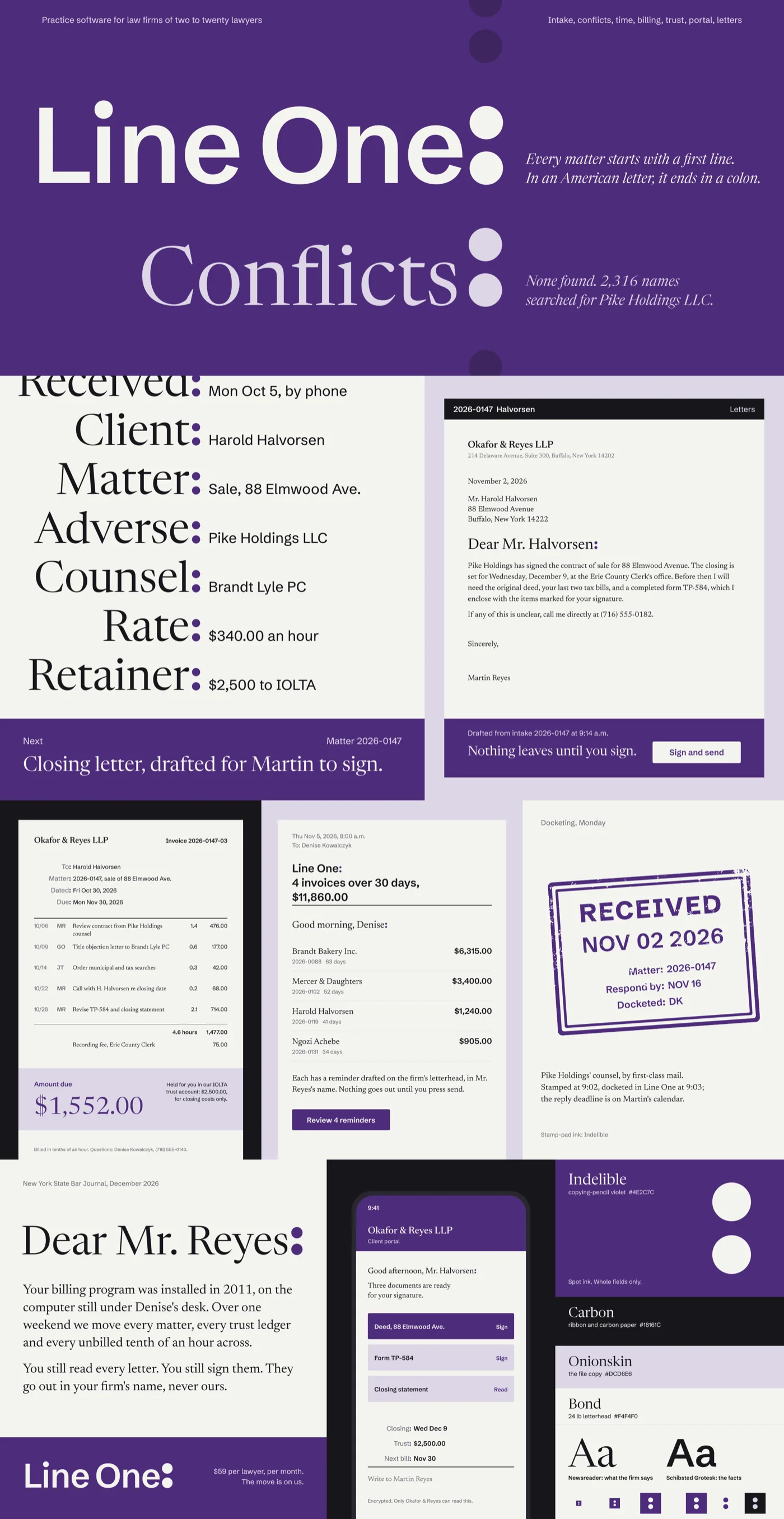
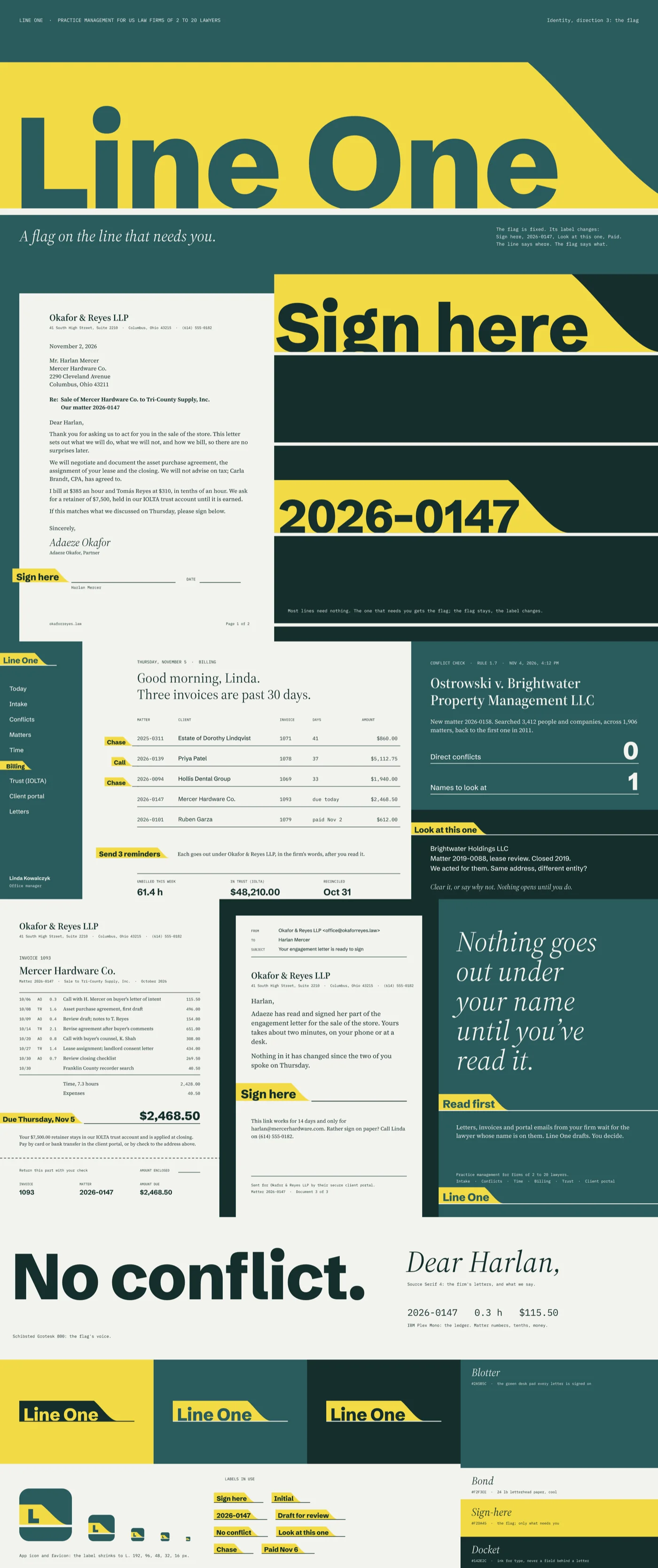
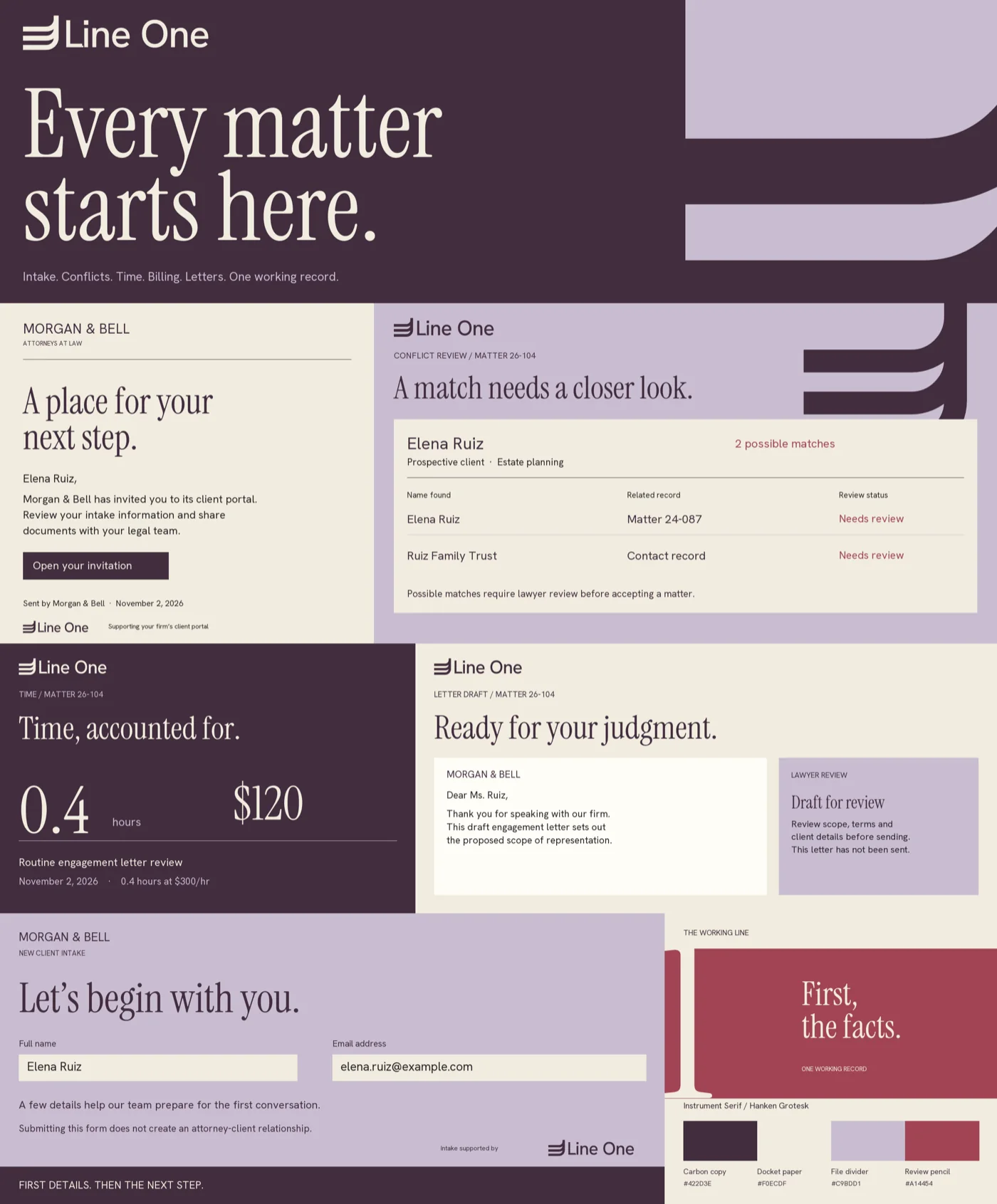
Three companies called Line One.
Small-firm legal software, fictional. All three come from one single run on Claude, each built by its own subagent. Direction 1 was free, directions 2 and 3 were pushed away from defaults. The strong prompt scored 4.50 on this brief. Both judges rated how different these three are at 4 of 5: the look and personality change, but they share one law-office-paper world of letterheads, invoices and matter numbers. The same boards got 3 of 5 in the last panel, so read that as a range. We show this trio because Claude's lau trio was closer, at 2 and 3, all three on the lukewarm idea.
Direction 1, free. Panel 4.40
Ms. Whitcombe is on line one.
The L in Line One is a 1, and its foot is line one: everything the firm says (the call, the letter, the trust balance) is written standing on that line.
Risk. A heavy Clarendon on brick red and canary can tip into Americana nostalgia (diner menu, rail timetable) if the type is ever set loose or decorated; and some people will read the symbol alone as a plain L and never see the 1.
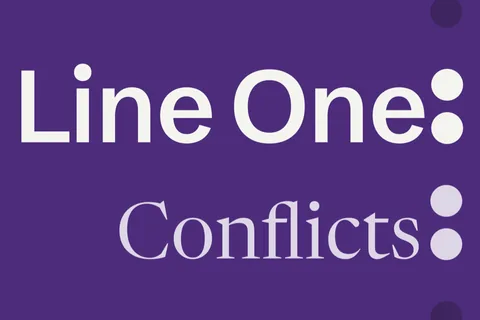
Line One owns the colon that ends the first line of every American business letter ('Dear Mr. Halvorsen:'), the pause before a firm speaks, and lines every colon up into one spine, the way a well-set intake sheet does.
Risk. The mark is a well-chosen grotesque plus one drawn glyph: its drawing is in proportion and placement, not in letter surgery, so a hostile reviewer can call it a font with big dots. Two round dots also sit near generic 'more' and 'drag handle' icons in UI.
Both judges flagged the word "Received:" on this board. It's clipped at a panel edge.
Nothing goes out under your name until you've read it.
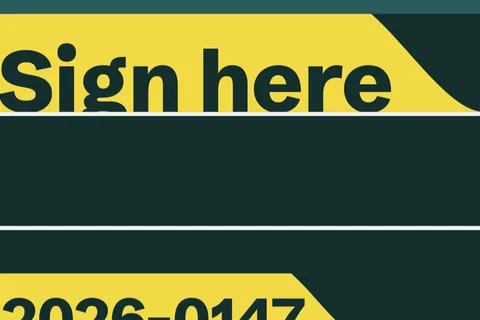
Line One puts a sign-here flag on the one line that needs you: the flag never changes, only its label does.
Risk. Below about 40 px the flag can read as a highlighter swipe or a road sign, and the 16 px favicon's L is mush. Yellow on green sits near John Deere and shares a hue pair with Actionstep's secondary colours; it only stays ours while the green stays a desaturated blue-green, the yellow stays under a fifth of any layout, and there is no navy anywhere.
Six of the skill's 18 boards from this round, cropped to a strong panel, each with the risk the skill wrote down. Open any full board. We picked the ones we think are strongest, plus one ordinary Codex board, so most of this is a highlight reel. Codex boards remain weaker overall: 2.50 against Claude's 4.27 on the recommended direction, and no Codex direction beat the prompt. Scores are from the best-of-three panel, where judges saw the prompt's board and all three directions from the same agent. Names are illustrations, not recommendations, and may coincide with real companies. People, figures and test results on the boards are invented. Claude's boards are all code route. The Codex ones here are hybrid, with marks explored in an image tool and rebuilt in vector.
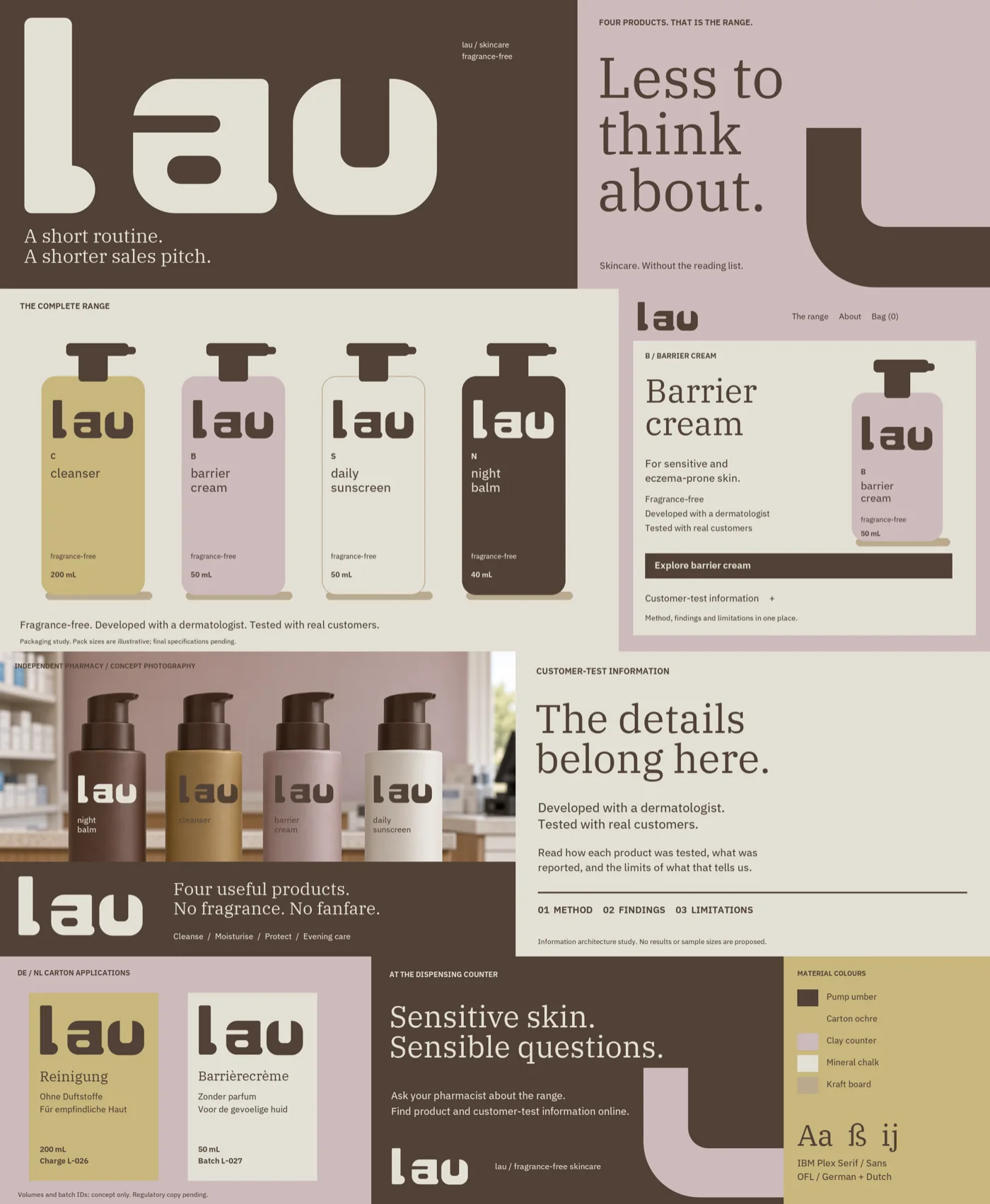
lau, direction 3. Claude. Panel 4.80Eczema skincare
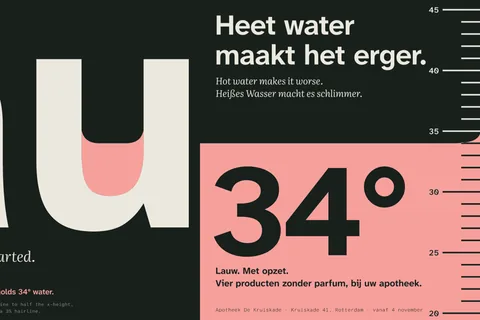
lau means lukewarm, so everything lau makes is a vessel filled to one honest number, starting with the u, which holds water at 34 degrees.
Risk. A pink, round-bottomed pool inside a u can read as a tongue in a mouth, at mid sizes on the symbol especially. The flat meniscus top is what stops it, so it must never be simplified to a plain rounded blob. Calamine pink also has to stay a spot: if marketing floods packs above about 35% fill, it drifts towards clean-beauty pink.
Strong prompt on this brief 3.00. Read the caveat beside the win.
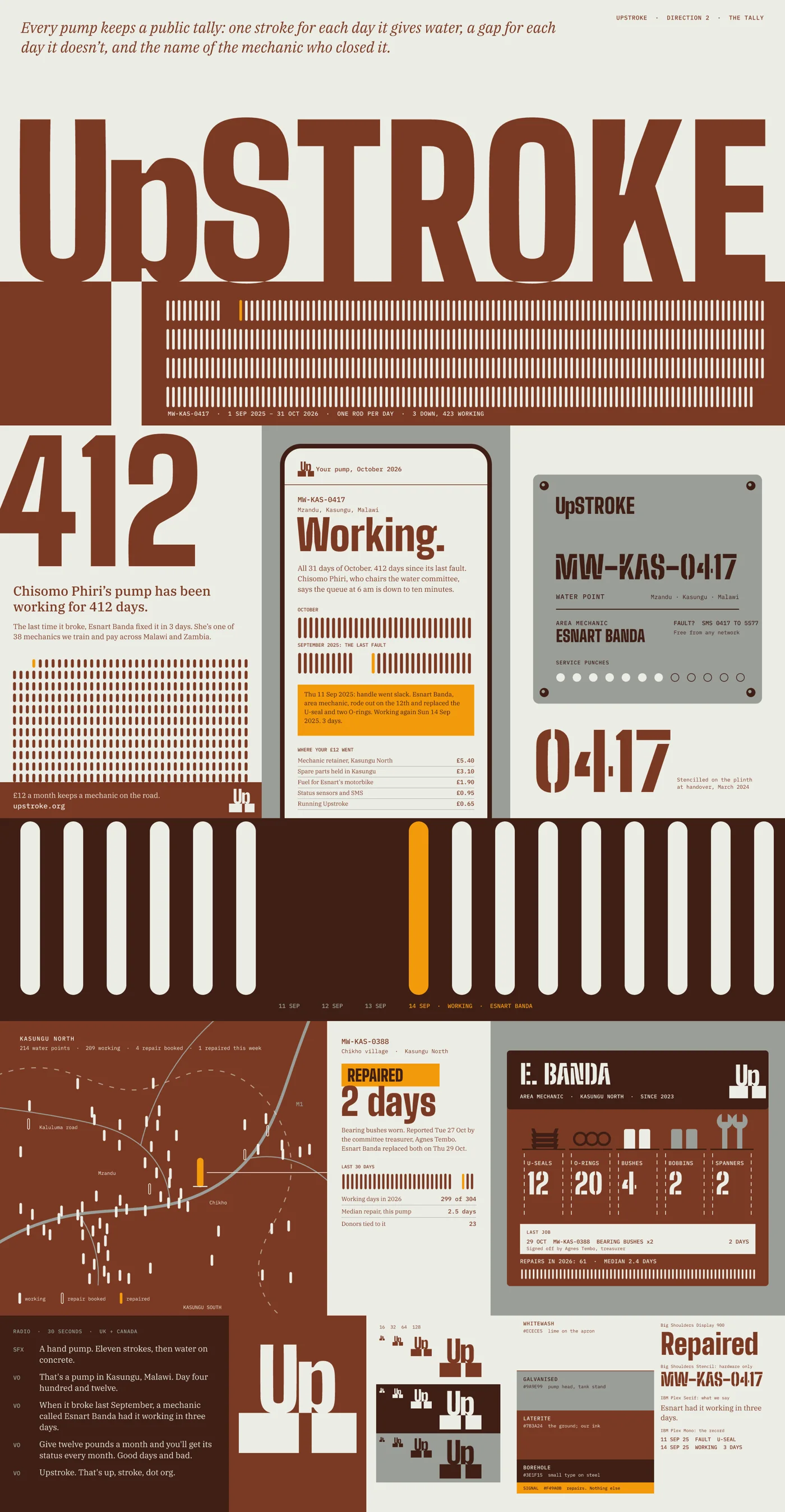
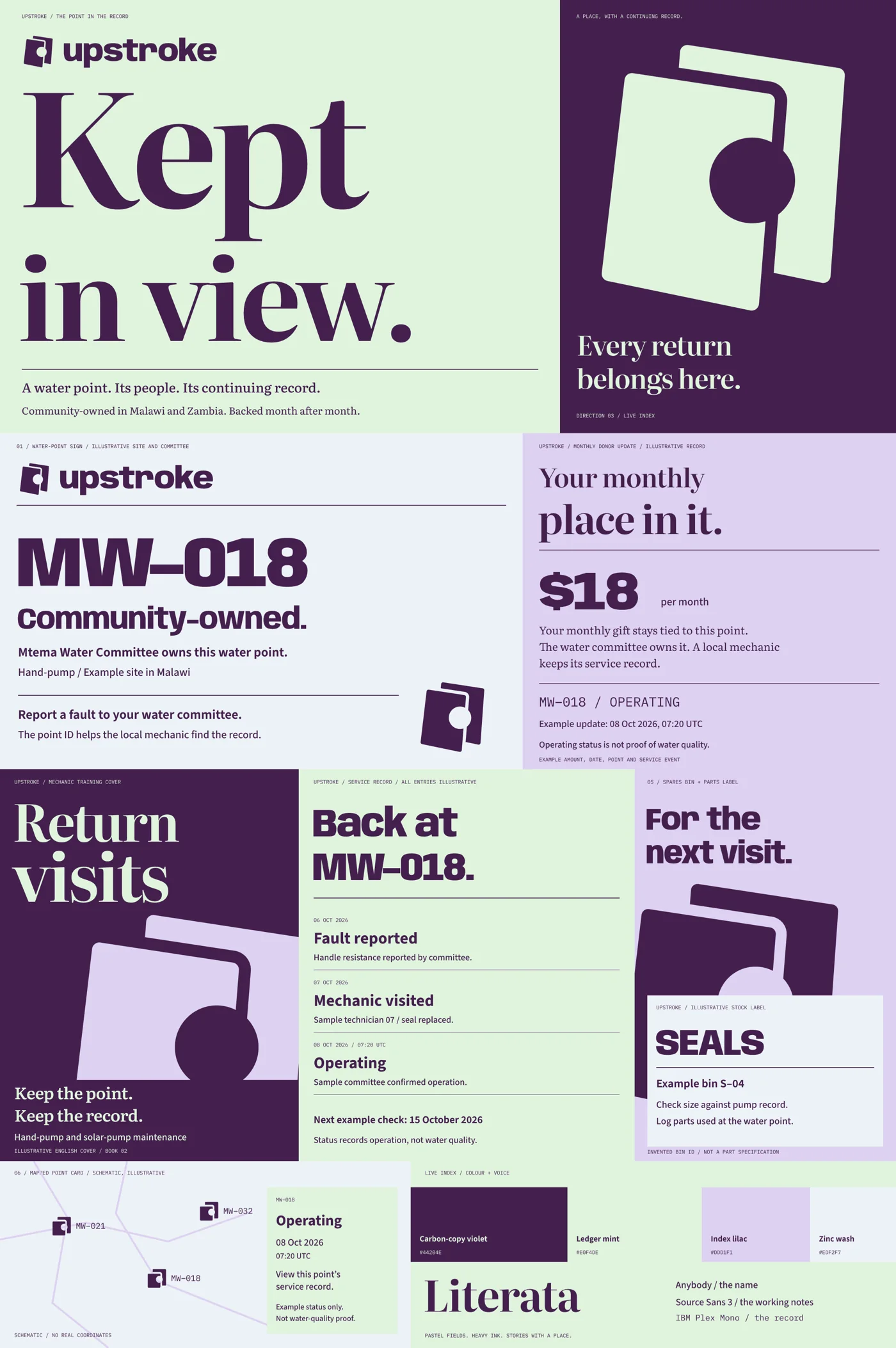
Upstroke, direction 1. Claude. Panel 3.90Water-point non-profit, Malawi and Zambia
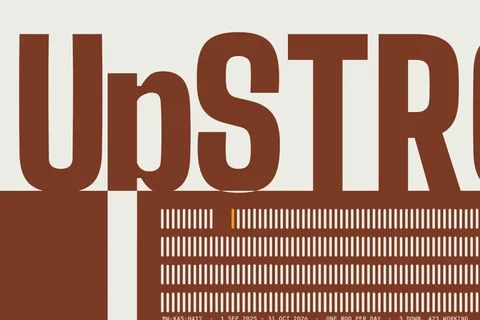
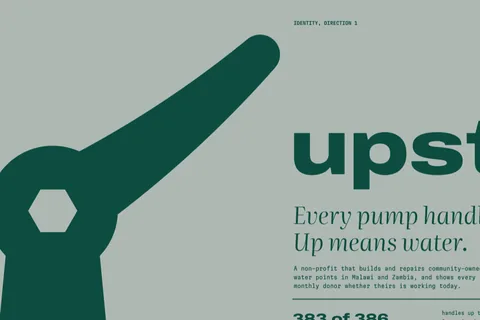
Every pump handle is a signal: up means water, and every day of a donor's pump is drawn as its handle, up or down, in public.
Risk. A pump handle is the obvious picture of the name; some readers will see a lever, a crane arm or a tap before they see a pump. And with no blue anywhere, the word 'water' has to be carried by copy, not colour.
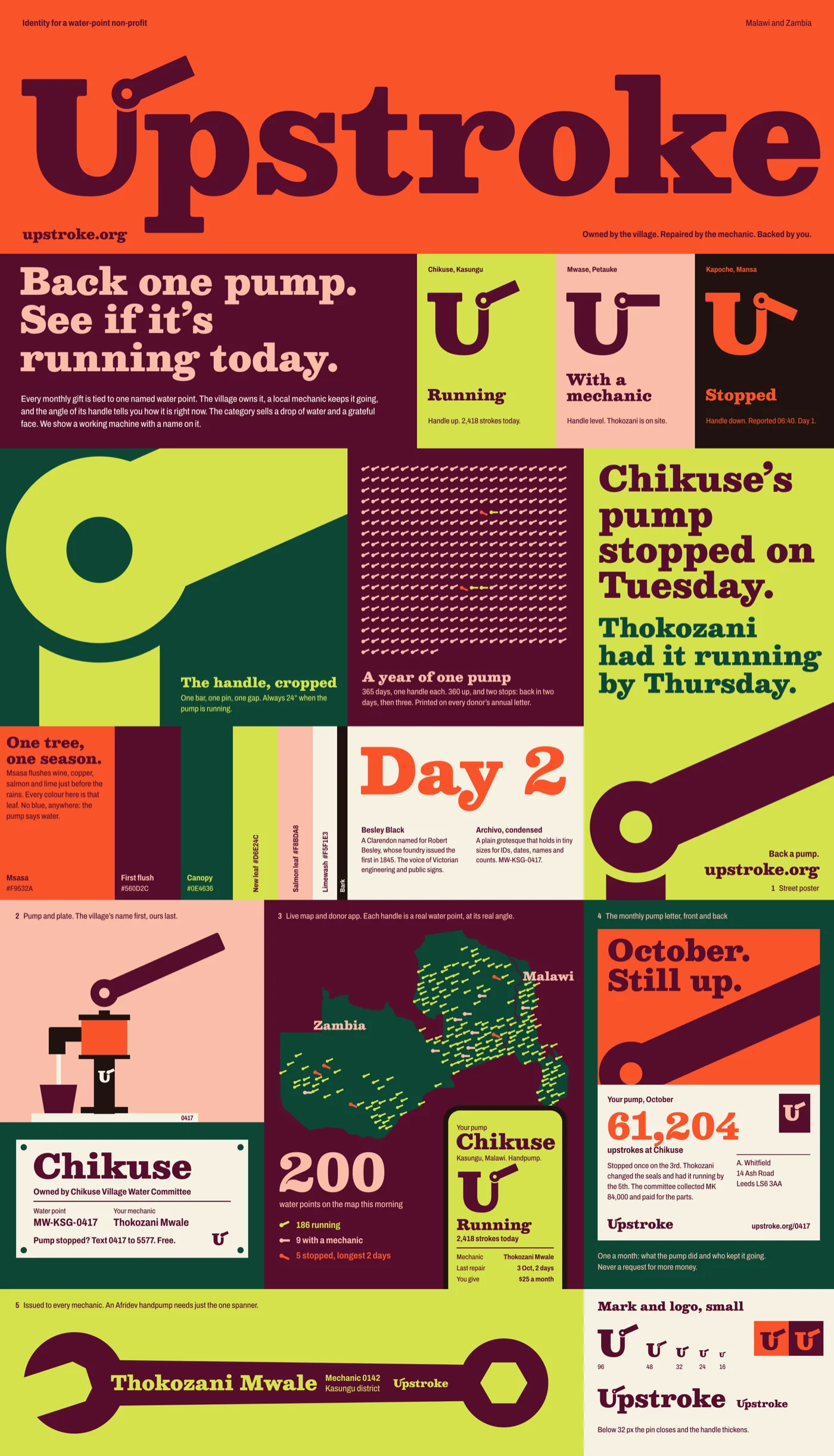
Strong prompt on this brief 4.90. A loss, shown above.
Upstroke, direction 2. Claude. Panel 3.80Water-point non-profit, Malawi and Zambia
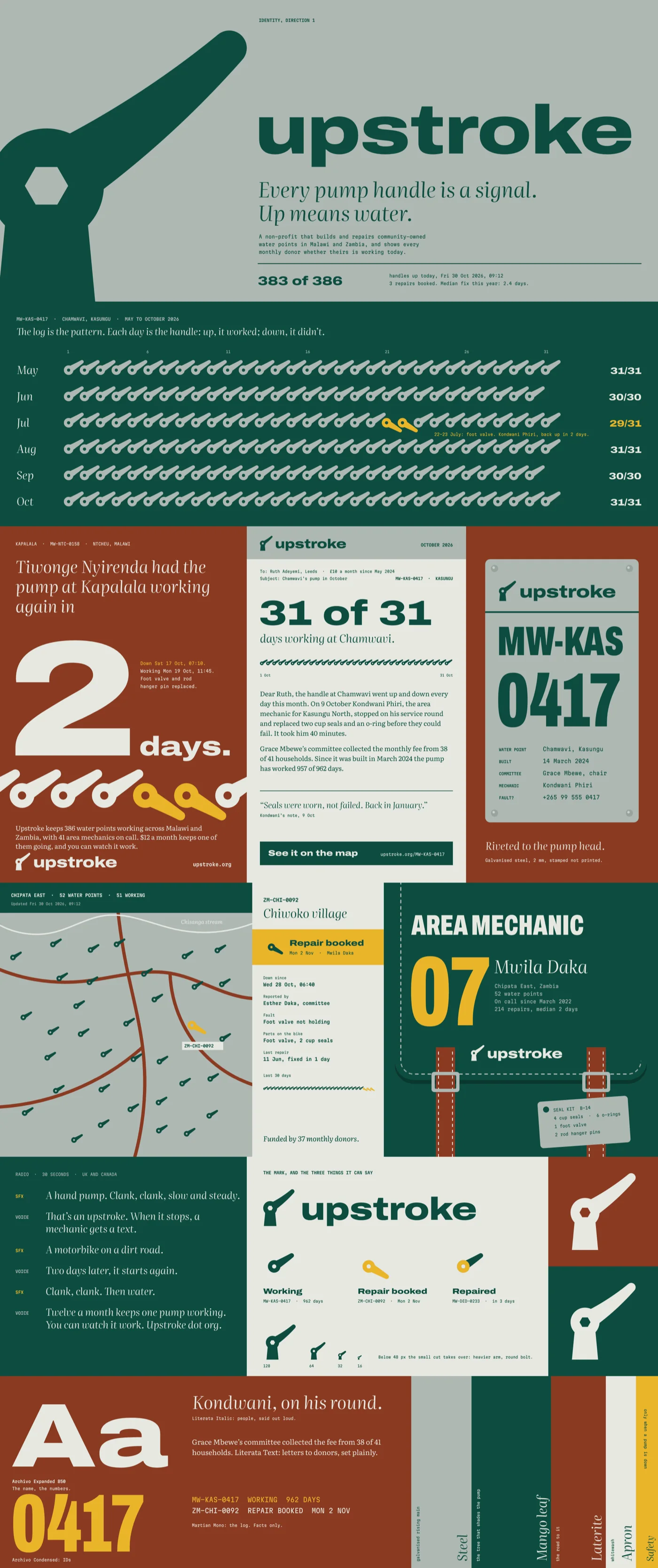
Every pump keeps a public tally: one stroke for each day it gives water, a gap for each day it doesn't, and the name of the mechanic who closed it.
Risk. It is honest by design, so it shows failure: every board, email and poster carries a gap. A bad quarter will show up in the brand itself. And the mark is lettering on a ground band, not a pictorial symbol: it leans on the lowercase p, and only reads as a pump rod once you've been told.
The one the skill recommended on this brief. Strong prompt on this brief 4.90.
Line One, direction 1. Codex. Panel 3.90Small-firm legal software
Line One gathers the working lines of a legal matter into one continuous record.
Risk. The three returning rules can resemble a transport or wing mark. Plum is not an unoccupied legal-tech colour, and MyCase also has a purple favicon, though its staggered page silhouette differs. This needs visual similarity and trademark screening before use.
Codex's best on this brief. Strong prompt, same agent, 4.80. The skill recommended direction 3 here, at 2.90.
lau, direction 2. Codex. Panel 3.70Eczema skincare
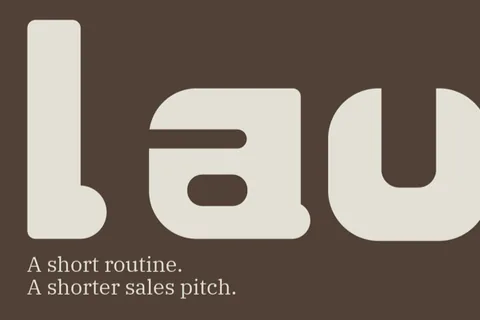
lau turns the cupped return of its u into a sheltering edge for four useful products and the facts that belong with them.
Risk. The earth materials may suggest homewares or natural beauty before pharmacy; clear product names and factual information must carry the clinical context.
Codex's best on this brief. Strong prompt, same agent, 4.40. The skill recommended direction 1 here, at 2.50. The shelf photo is generated, by the run's own record.
Upstroke, direction 3. Codex. Panel 2.70Water-point non-profit, Malawi and Zambia
Upstroke keeps each shared water point punched through its continuing service record.
Risk. Without its applications the symbol can read as a documents icon. It has not been screened for similarity. The serif is deliberately editorial and should be tested for warmth with both communities and monthly donors.
An ordinary Codex board. Strong prompt, same agent, 4.80. The skill recommended direction 2 here, at 3.50.
The naming skill picked Already Looked. It's the reply to "is that taken?" and "does that logo actually work?". The branding skill drew the identity you're reading. Both ran headless, and the commissioning prompt made the final selection step automatic.
What that shows: the skills run end to end, and the kit holds up on a real page.
What it doesn't show: that the name is good, that it's clear of conflicts, or that you'd have picked it. The marks are unregistered and not cleared.
How it worksGreen means you decide
It stops and asks.
Naming
Reads the project.
You answerAt most 5 questions, and it shows real names for you to react to.
Researches competitors and the customer's world.
Writes angles.
Bans its own first thoughts.
Separate teams generate: the real brief, disguised as a rival, disguised as another category, and a senior open pass. Each with drawn random worlds, personas, letters and shapes.
A script filters.
A separate judge scores.
Runs the checks.
5 to 7 names, each with a story and one honest risk.
You reactIt learns, or restarts clean if you hate everything.
Naming kit.
Branding
Strategy and onliness.
Reads real colours from competitors' sites.
Three directions in separate top-tier subagents, each a whole world: a mark, a graphic device, colour, type and applications on one board. Direction 1 is free. Directions 2 and 3 are pushed away.
Renders and looks at 16, 32, 64, 128 and 512, in light, dark and one colour.
A critic reviews and sends back what fails.
You pickNothing else gets built until you do. Reject all three and it restarts clean.
The kit.
The kit
SVG and PNG logo set (horizontal, stacked, symbol, wordmark; primary, reversed, mono), favicon set, app icons, OG and GitHub social images, the font files with their licences, tokens (CSS, Tailwind 4, DTCG, SwiftUI, Android, Figma), posters and labels as PNG and SVG with the scripts that drew them, guidelines page, BRAND.md and DESIGN.md for your agents, voice, and context extras for mobile, CLI, physical, restaurant and open source.
How the marks get made
From a short script of named parameters, or from a generated image traced to clean vector. Never from hand-typed path data. Image generation is used when the agent has it: Codex, Cursor, or any connected tool. The code route works without it, and is what Claude Code uses by default. Fonts are OFL only. The logo on this page came from the skill.
What it draws on
Lexicon's blind teams and diamond, Igor's taxonomy and pre-screening, Watkins's SMILE and SCRATCH, Altman's bad-name purge. Verbalized sampling (Zhang et al., ICML 2026 poster): asking for probabilities raised diversity 1.6 to 2.1 times.
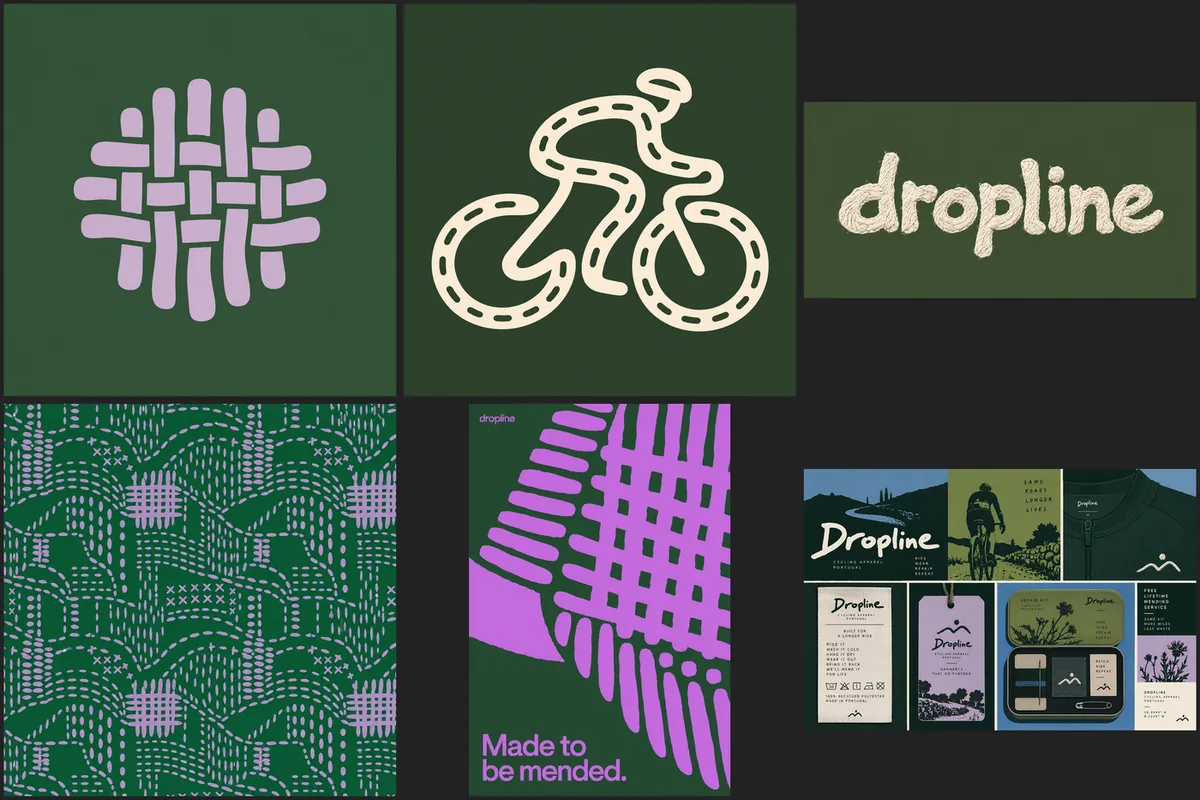
The image route testDropline, six prompts
Raw images from an agent's image tool, before any tracing. The rider is the kind of figurative mark the code route can't draw. Nobody scored this: it's one test, looked at. Compare the code route's board.
Fictional brief. Draft, not cleared.
What it checksA/L is checked by script. C/S comes with a link for you
A/L or C/S. Never a shrug.
A/L means already looked: a script went and read it. C/S means couldn't see: the source can't be read honestly, so you get an exact link and the job. Same size type, on purpose.
Surface
already looked
couldn't see
Trademark registers
None. No free scriptable trademark API exists.
USPTO, TMview, WIPO, UKIPO: exact links, or your agent's browser tool with you watching.
Domains
RDAP, plus WHOIS for .io, .co, .me, .sh, .so and .de.
Bluesky and Substack. X, YouTube and TikTok when they answer an honest request.
Instagram, Threads, Facebook, Reddit, Product Hunt, Medium. X, YouTube and TikTok when they don't answer.
Words
Wikipedia, Wikidata, Wiktionary meanings with vulgar senses flagged, Datamuse sound-alikes.
Any probe that fails.
A failed probe is C/S, never "free".
A real case it catches: rdap.org returns 404 for github.io, so looking up .io there says it's free when it isn't.
A knockout screen of public sources, not legal clearance. See a trademark attorney before you launch, file or spend money.
The numbersRuns 2026-11-01 and 2026-11-02
Where it won. Where it lost. What it costs.
Naming: fictional held-out briefs, 2 runs per brief, arm and agent, on Claude Sonnet and Codex gpt-6.1-terra. Plain is "suggest 6 names". Strong prompt is an expert persona, originality demands and web search. Branding: 3 briefs, no longer held out, 1 run per cell, on the same top-tier budget. A strong prompt still beats the skill's recommended direction there. If you want one deep identity, use this.Method and how to reproduce it.
Where it lost, or can't claim a win
Branding: a strong prompt still wins on the recommended direction. Claude Opus 4.67 against the skill at 4.27. On Codex, 3.40 against 2.50. All judges, skill minus prompt: -0.65 [-0.85, -0.50], outside noise. About $3 a run against about $14.
On Codex, no direction beat the prompt. 0 of 3, -0.90 on average. A harness line telling runs not to open a viewer looked like the cause. We fixed it and reran both arms, and the gap barely moved: -1.04 to -0.90. We don't know the cause.
Best of three on Claude is one win, and it rests on one brief. 1 of 3, +0.23 on average. The prompt's lau board scored 4.50 in an earlier panel and 3.00 in this one, because panel scores are relative to what's beside them. Without lau, Claude's mean is -0.55.
Re-judging moves scores. The Claude boards are the identical files in the last two rounds. Best of three went from win, loss, tie and +0.47 to win, loss, loss and +0.23. The same Upstroke prompt board went from 4.50 to 4.90. Treat differences under about 0.4 as noise.
The recommendation misses. Direction 1 was the panel's best in 4 of 6 runs. The recommendation chose it in 2 of 6 and matched the panel's best in 0 of 6. The sentence we added for this hasn't been run on Claude. The Codex rerun read it, on one run per brief.
The directions are closer than we'd like. Judges rated how different they are as companies: 3.00 of 5, against 3.00, 2.75 and 3.25 in earlier rounds. Claude's lau is 2 and 3. A "pass on facts, not ideas" rule went in before these runs. It's within noise, so we can't say it helped.
These briefs aren't held out any more. The same three have been through four rounds. A fresh set would be fairer.
No person has judged this. LLM judges share the models' taste, so the panel can't separate quality from typicality. No human designer or client has judged any of this.
On Codex with gpt-6.1-terra, the naming skill does worse. Against a strong prompt: -0.47 [-0.75, -0.15]. It came last of six.
Which model runs the session matters on Codex. In a follow-up blind panel, the skill scored 2.32 on gpt-6.1-terra, 3.45 on gpt-6.1-sol and 4.10 on Claude Sonnet, against 3.47 for a strong prompt on Terra. A run on Sol takes 13 to 27 minutes. On Codex, use codex -m gpt-6.1-sol.
On Claude against a strong prompt, naming. +0.27 [-0.12, +0.71]. Within noise, so we can't claim it.
Direct collisions. 1% against 1%. A strong prompt with web search already ties it.
Price. See below. It costs far more than a good prompt, every run.
Branding, blind board panel
Claude Opus and gpt-6.1-sol judging one board per run. Scores 1 to 5, mean rank among 4.
Arm
Score bar
score
rank
Strong prompt on Claude Opus
4.67
1.33
Skill on Claude
4.27
1.67
Strong prompt on Codex
3.40
3.00
Skill on Codex
2.50
4.00
All judges, skill minus prompt: -0.65 [-0.85, -0.50], outside noise.
Skill over prompt, same agent: 33% of panels on Claude, 0% on Codex.
Judge agreement: Spearman 0.87.
Previous round, for comparison: Claude 4.37 against 4.60 on the same boards, Codex 2.43 against 3.47 on boards since redone.
Branding, best of three
The prompt's one board against all three of the skill's directions, same agent, shuffled. A person gets to choose, so this gives the skill more chances. Best direction in bold.
Brief
prompt
d1
d2
d3
gap
lau, Claude
3.00
3.80
4.10
4.80
+1.80
Upstroke, Claude
4.90
3.90
3.80
3.20
-1.00
Line One, Claude
4.50
4.40
3.30
3.40
-0.10
lau, Codex
4.40
2.50
3.70
2.60
-0.70
Upstroke, Codex
4.80
3.70
3.50
2.70
-1.10
Line One, Codex
4.80
3.90
2.80
2.90
-0.90
1 of 3 on Claude, 0 of 3 on Codex. Mean gap: +0.23 on Claude, -0.90 on Codex. Without lau, Claude's mean is -0.55. Earlier rounds: 1 of 3 on both, +0.47 and -0.60, and before that 0 of 3 on both, -0.40 and -0.80. Three briefs, one run each.
Naming, measured
6 briefs. Automated metrics, no judges.
Metric
plain
strong prompt
skill
Same names between runs of one brief (Jaccard, lower is more different)
0.17
0.12
0.02
Names hitting a measured default
19%
6%
0%
Starting with T, S, P or C
28%
38%
23%
Direct collision: live product with the name in the same category (LLM with web search)
12%
1%
1%
Naming, blind panel
Claude Opus and gpt-6.1-sol judging anonymous name-and-idea lists. Scores 1 to 5, mean rank among 6.
Arm
Score bar
score
rank
Skill on Claude
4.12
2.00
Strong prompt on Claude
3.84
2.33
Plain on Claude
3.12
3.54
Strong prompt on Codex
3.12
3.92
Plain on Codex
2.68
4.33
Skill on Codex (gpt-6.1-terra)
2.65
4.88
On Claude, skill vs plain: +1.00 [+0.83, +1.17], outside noise.
On Claude, skill vs strong prompt: +0.27 [-0.12, +0.71], within noise.
On Codex (terra), skill vs strong prompt: -0.47 [-0.75, -0.15], a loss.
Differences with briefs resampled.
Cost and time
Per run, at list price. Codex reports tokens only. Branding stops at the three directions: the kit is scripted and wasn't part of this test.
Skill
plain
strong prompt
skill
Naming, Claude Sonnet
$0.015 9 sec
$0.15 38 sec
$3.15 10 min
Branding, Claude
n/a
~$3 14.7 min
~$14 26.1 min
Branding, Codex
n/a
8.4 min
18.1 min
Plainly: if you want one deep identity, use the prompt. The skill is for when you want a real choice and a kit you can ship, and you're paying about five times as much for that. On Codex, the prompt also scores higher than any direction.
Superseded: logo cards
Our first branding test. One logo on a neutral card, against a prompt that only asked for a logo. Older skill, weak panel (Spearman 0.33).
It said small-size legibility 3.88 against 2.25, overall 3.22 against 2.98, within noise. We keep it in the method page as history. Don't use these numbers.
Limits
A knockout screen of public sources, not legal clearance. See a trademark attorney before you launch, file or spend money.
The US copyright position on AI-assisted logos is unsettled. The Copyright Office's 2025 report says prompts alone don't give authorship. Human selection and editing can help. Trademark is the protection that matters for a logo.
Mascots and figurative marks are now possible through the image route, and still weak in code. A generated mark has weak copyright, so check it.
The judges are LLMs and share biases with the models whose work they score, so the branding panel can't separate quality from typicality. No human designer or client has judged any of this. Read the lists and look at the boards yourself.
The Cursor Free plan hit its usage limit during measurement, so Cursor wasn't evaluated beyond default measurement and compatibility tests.
Fictional briefs may coincide with real companies. Gallery names are illustrations, not recommendations, and weren't cleared. People, figures and test results on the boards are invented.
On Codex, use the naming skill, with codex -m gpt-6.1-sol. For one deep identity, use the one prompt: no branding direction beat it there. Use the branding skill only if you want the three directions, the checks and the kit.
Cursor
npx skills add juztripper/already-looked -a cursor
Then /naming and /branding, or ask. Cursor passed compatibility tests but wasn't evaluated beyond them, because the Free plan hit its limit.
Needs Python 3.10+. The branding skill also needs uv.
Stays local. Everything these skills write stays in brand/ in your project. Every host it contacts.
The plain pathFor people naming a shop
I don't code.
You won't write any. You do need a coding agent, because the checks are scripts that run on your computer. An ordinary chat window can suggest names, but it can't run those.
1. Get an agentClaude Code, Codex or Cursor. Each has its own account and plan, and you pay for what the runs use. Make an empty folder for your project and open the agent in it.
2. Paste this
Install the skills from github.com/juztripper/already-looked, plus anything they need to run.
3. Say what it's forIn your own words. Change the example.
I'm starting a mobile dog-grooming business in Leeds. Help me name it, then draw the brand.
Then answer its questions and react to what it shows you. Measured headless at list price: 10 minutes and $3.15 for names on Claude Sonnet, 26.1 minutes and about $14 for three brand directions on Claude. Your answers add time. When it says C/S, that one's on you: open the link and look.
QuestionsThe ones people actually type
Asked and answered.
Is this a brand name generator?
Yes, a slow one. It reads your project, asks at most 5 questions, researches your category, and generates from separate disguised teams. Then it filters and checks, and shows 5 to 7 names, each with a story and one honest risk. A run on Claude Sonnet took 10 minutes and $3.15 at list price. If you want a long list right now, other tools do that.
How do I check if a name is taken?
Ask your agent to run the naming skill on it. A script checks domains, package registries, GitHub, Docker Hub, the iOS App Store, Wikipedia, Wiktionary and several social handles. For what it can't read, such as trademark registers and Instagram, you get an exact link and a plain "couldn't see". A failed check is never reported as free. The full list.
Does this do trademark clearance?
No. It is a knockout screen of public sources, not legal clearance. No free scriptable trademark API exists, so registers are given as exact links for you to check, or your agent's browser tool searches them with you watching. See a trademark attorney before you launch, file or spend money.
Can I use the logo commercially?
The skills are MIT and put no restriction on what they make for you, and fonts are OFL only. Two things to know. The US copyright position on AI-assisted logos is unsettled: the Copyright Office's 2025 report says prompts alone don't give authorship, and human selection and editing can help. A mark from an image generator has weak copyright, so check it. Trademark is the protection that matters for a logo, and nothing here clears or registers one.
Why not just ask ChatGPT?
You can, and a good prompt gets you far. In our test a strong prompt on Claude cost $0.15 and scored 3.84. The skill cost $3.15 and scored 4.12, a gap within noise. What a prompt doesn't give you: different names on every run (same-name overlap 0.12 against 0.02), scripts that actually probe registries, three directions rendered and inspected at five sizes, and a kit. For branding, a strong prompt still beat the skill's recommended direction on our blind panel, 4.67 against 4.27 on Claude and 3.40 against 2.50 on Codex. If you want one deep identity, use that prompt.
How much does it cost?
The skills are free and MIT. There is no paid tier, no accounts, and no API keys needed. You pay for your own agent's model use. At list price a naming run on Claude Sonnet was $3.15 and 10 minutes. A branding run up to the three directions was about $14 and 26 minutes on Claude, and about 18 minutes on Codex. Codex reports tokens only, so we have no dollar figure for it.
Do I need to know how to code?
No, but you need a coding agent, because the checks are scripts that run on your computer. Here is the plain path.
What does it send over the network?
No telemetry. Nothing is uploaded. Candidate names go to the public endpoints that check them, one request per second per host, with a truthful User-Agent. If you use the branding skill's image script, it sends image prompts to OpenAI or Gemini when you've set a key, or runs the Codex CLI. Output stays in brand/ in your project. Every host is listed in SECURITY.md.